
Index
- POLYURETHANE PAINT or WATER-BASED PAINT?
- NON-FILM-FORMING PRODUCTS: STAINS, DYES, OUTDOOR WOOD PRESERVATIVES (POLYURETHANE PAINT AND WATER-BASED PAINT)
- FILM-FORMING PRODUCTS: PRIMERS, FINISHES, AND ENAMELS
- WATER-BASED PAINTS: HOW TO USE THEM?
- SPECIAL PRODUCTS FOR WOOD CARE AND MAINTENANCE: OILS AND WAXES
POLYURETHANE PAINT or WATER-BASED PAINT?
Changing the style of your bookcase or renewing shutters, enhancing an old cupboard or refurbishing garden furniture. Repainting the doghouse or the iron gate, turning an old bench into something new. With a little creativity, some guidance, and, above all, the right tools, anything is possible.
But how do you navigate the jungle of paints? Water-based or solvent-based? Oils, enamels, waxes, preservatives? What’s the difference? Which products preserve the wood’s natural tone, and which ones change it? Let’s find out.
Wood paints can be classified both by formulation and by the substrate they are applied to.
By formulation, wood paints are divided into:
- water-based wood paint;
- solvent-based wood paint.
What’s the difference between water-based and solvent-based wood paints?
In the Rio Verde line by Renner Italia, water-based paint contains 30–90% water and is formulated with acrylic resins. The water evaporates quickly, as does the cross-linking of the binder. It is diluted with water, offers medium-high elasticity, medium-high chemical resistance, medium-high weather resistance, and medium-high gloss.
Solvent-based paint, also called polyurethane paint, contains 30–90% solvent and is based on polyurethane resins. It must be diluted with chemical thinners, has medium-low elasticity, high chemical resistance, medium-low weather resistance, and high gloss.
By substrate, wood paints are divided into:
- interior wood paints (furniture, parquet, flooring, stairs, beams, attics);
- exterior wood paints (frames, claddings, garden furniture).
Thus, there are water-based paints for interiors, water-based paints for exteriors, solvent-based paints for interiors, and solvent-based paints for exteriors.
Accurate classification is essential to meet consumer needs precisely.
The three main types of coating products are:
- non-film-forming products;
- film-forming products;
- special products.

NON-FILM-FORMING PRODUCTS: STAINS, DYES, OUTDOOR WOOD PRESERVATIVES (POLYURETHANE PAINT AND WATER-BASED PAINT)
STAINS. Stains are indoor colorants generally applied as the first treatment on raw wood. Their function is to give wood the desired color while allowing the grain to remain visible, and they consist of solutions or dispersions of dyes in solvent or water.
DYES. In wood finishing, dyes (or mordants) are simple stains made of dyes dissolved in water.
OUTDOOR WOOD PRESERVATIVES. For outdoor furniture, before any other treatment, it is advisable to use a wood preservative. It is a paint designed to protect wood exposed to weathering — windows, shutters, garden furniture, claddings. Rio Verde preservatives are available in both water- and solvent-based formulas, and they allow the grain of the wood to remain visible. Specifically, they:
- protect wood from humidity and biological attacks (mold, fungi) through an extraordinary nanometric binder;
- enhance the beauty of the wood and color it uniformly thanks to transparent iron oxides that absorb UV radiation;
- prevent oxidation of lignin, the main component of wood;
- penetrate deeply, depositing free-radical absorbers that slow natural aging.
Rio Verde by Renner Italia offers several options:
classic water-based preservative,
water-based wax-effect preservative,
water-based gel preservative (ideal for vertical surfaces),
classic solvent-based preservative,
and solvent-based wax-effect preservative.
FILM-FORMING PRODUCTS: PRIMERS, FINISHES, AND ENAMELS
PRIMERS. Water-based primers prepare the wood for finishing, evening out the surface and acting as fillers. The number of coats depends on the substrate. In the Rio Verde range, there are only water-based primers for furniture, as outdoor coatings don’t require primers.
FINISHES. A varnish or finish is a transparent coating product that forms a continuous or discontinuous film on the surface. It may have a light tint while still showing the wood grain.
Water-based and polyurethane finishes for exterior use. Rio Verde’s outdoor finishes—both water- and solvent-based—follow the natural movement of the wood, preventing cracking. They block UV rays, repel water, allow breathability, and are extremely elastic, soft, and transparent. Options include:
classic water-based finish,
wax-effect water-based finish,
high UV-resistant water-based finish,
matte solvent-based finish,
and solvent-based flatting.
Interior finishes. For interiors, the Rio Verde range includes only water-based finishes—no polyurethane paints—ensuring low emissions and healthy indoor air. They are scratch- and abrasion-resistant, non-yellowing, and soft to the touch. Available in several versions, such as
matte water-based finish,
glossy water-based finish,
satin white finish,
and parquet finishes (semi-gloss or matte).
ENAMELS. Enamels are opaque pigmented finishes, available in solvent- and water-based formulations.
The solvent-based enamel was the first on the market but is not suitable for interiors.
The water-based enamel is newer, odorless, and safer, even for kitchens and bathrooms.
Rio Verde enamel protects both wood and metal, offering smooth, elastic, and UV-resistant coatings available in 10 colors.
WATER-BASED PAINTS: HOW TO USE THEM?
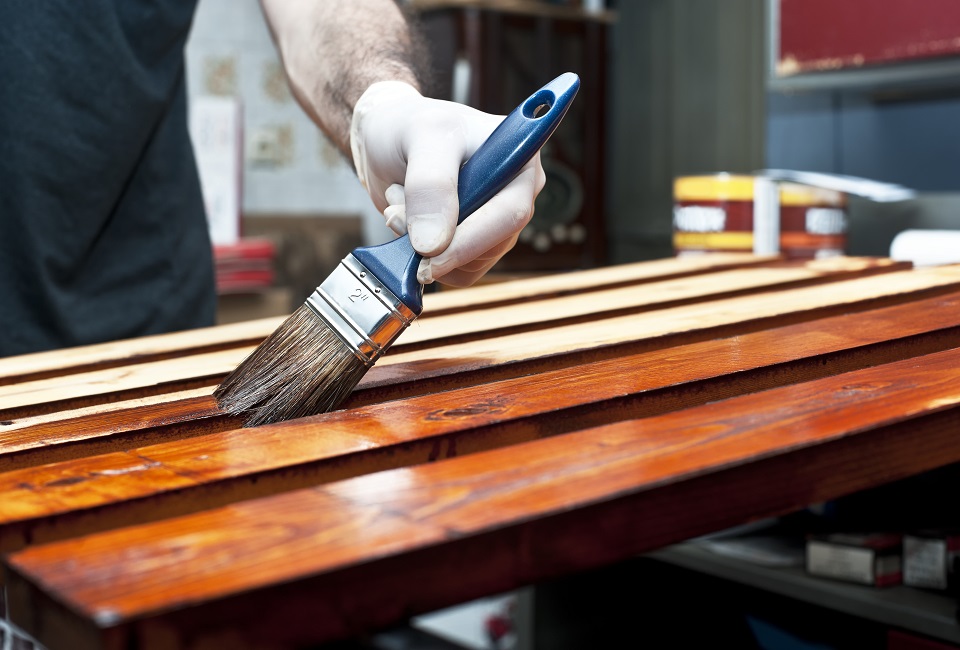
All Rio Verde products are designed for easy and safe brush application, even for private users. Application tools and methods are always indicated on the labels and technical data sheets.
SPECIAL PRODUCTS FOR WOOD CARE AND MAINTENANCE: OILS AND WAXES
Wood is a living material that must be maintained and nourished to stay in good condition. The first rule: remember to feed the wood.
OILS. The Teak Oil by Rio Verde gently nourishes exotic woods. Apply it twice a year to preserve their natural beauty.
Hi-Deck Hydro Oil is UV-, water-, and mold-resistant; it self-consumes (does not peel) and allows easy maintenance without sanding.
Decorative Oil 2-in-1 meets finishing, protection, and maintenance needs with iridescent colors.
WAXES. Wax revives, polishes, and protects wooden floors, slowing wear and masking scratches.
For example, the water-based parquet wax from Rio Verde should be applied periodically. Waxes are used for wood flooring but also for furniture with an antique look.
Rio Verde offers many auxiliary products for wood preparation, cleaning, and restoration, such as sealers, cleaners, and antiworm treatments.
